
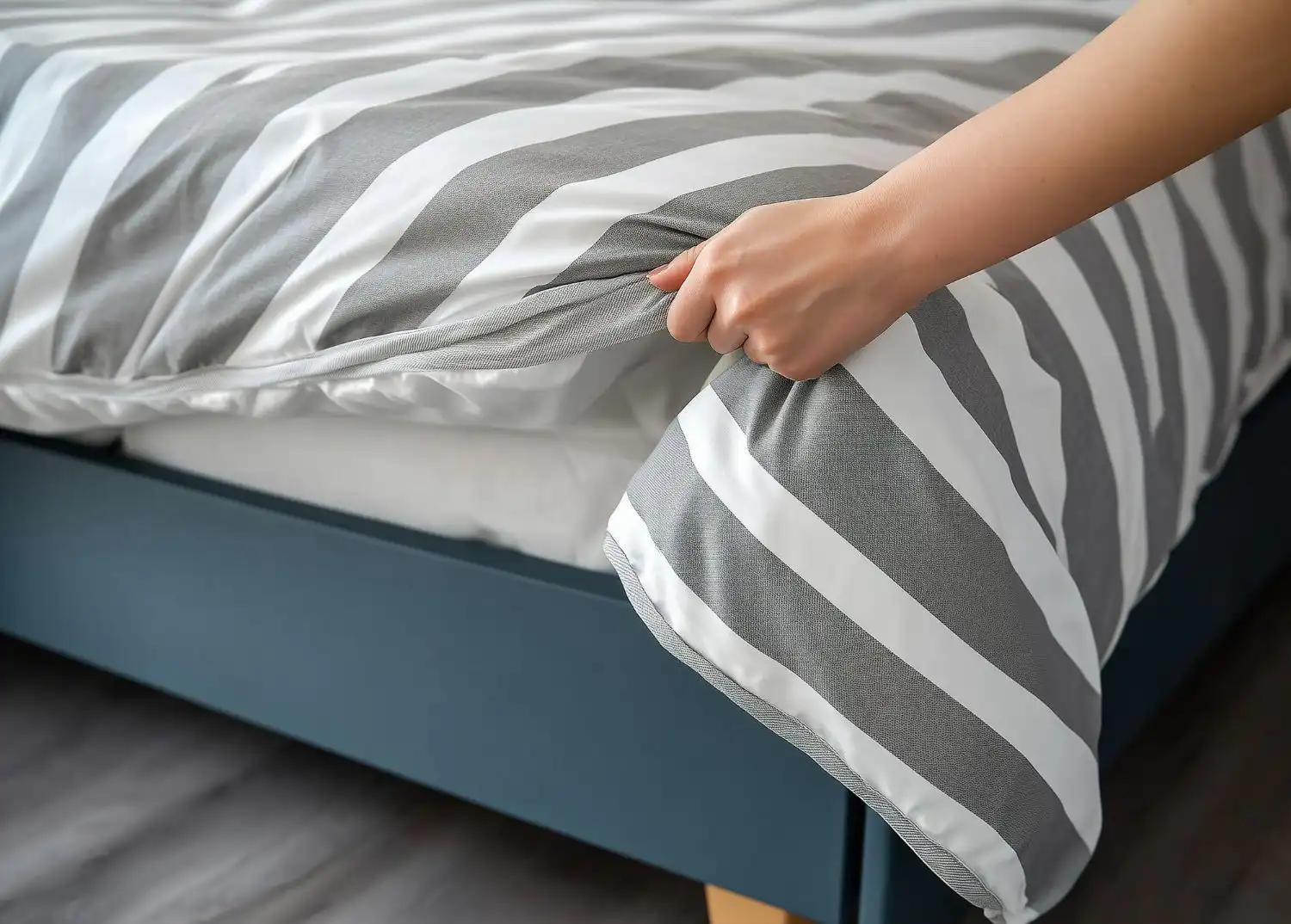
The fitted sheet is the most technically demanding item in a bedding set. A flat sheet or a duvet cover can hide small tolerances; a fitted sheet cannot. If the pocket is 2 cm too shallow, the corners pop off the mattress. If the elastic loses its recovery after twenty washes, customers return the product and leave a review. For brands and retailers building a bedding line under their own name, choosing the right private label fitted sheet manufacturer is therefore less about finding the lowest unit price and more about controlling specifications.
This guide explains the technical decisions behind a good private label fitted sheet: fabric construction, sizing and pocket depth, elastic systems, quality testing, labelling and the production workflow. It is written for purchasing managers, product developers and brand owners working with a manufacturer such as Jante Textile, which has produced bed linen and home textiles for export markets from Denizli, Turkey, since 1986.
What Private Label Manufacturing Means for Fitted Sheets
In a private label arrangement, the manufacturer produces the fitted sheet to your specifications and the finished product carries your brand, labels and packaging. You own the product identity; the manufacturer owns the production know-how.
There are generally two ways to work:
| Model | What the brand provides | What the manufacturer provides | Best for |
|---|---|---|---|
| Private label (stock base) | Brand labels, packaging, colour selection | Existing proven fabric and pattern | Fast market entry, lower MOQ |
| Custom / OEM development | Full tech pack, fabric specs, size chart, test requirements | Sourcing, sampling, production to spec | Established brands, differentiated products |
Most new brands start with the first model and move to custom development once sales data shows which sizes, colours and fabrics perform.
Choosing the Right Fabric
Fabric determines hand feel, durability, shrinkage behaviour and price. The four specifications to define are fibre content, weave or knit, yarn count and thread count (or GSM for knits).
Common Fabric Options for Fitted Sheets
| Fabric | Construction | Typical spec | Hand feel | Strengths | Considerations |
|---|---|---|---|---|---|
| Cotton percale | Plain weave (1/1) | 180–300 TC, Ne 40–60 | Crisp, matte, cool | Breathable, durable, hotel favourite | Wrinkles more easily |
| Cotton sateen | Satin weave (4/1) | 300–600 TC, Ne 60–80 | Smooth, lustrous | Premium look, drapes well | Lower abrasion resistance than percale |
| Poly-cotton (50/50, 60/40) | Plain weave | 144–250 TC | Firm, smooth | Low shrinkage, fast drying, economical | Less breathable |
| Cotton jersey | Single jersey knit | 130–160 GSM | Soft, T-shirt-like | Natural stretch, easy fit | Can pill; needs good yarn |
| Microfiber (polyester) | Brushed plain weave | 75–100 GSM | Very soft, peach-skin | Low cost, wrinkle resistant | Retains heat |
| Lyocell / bamboo viscose | Sateen or twill | 300–400 TC | Silky, cool | Sustainability story, moisture wicking | Higher cost, gentle care |
A Note on Thread Count
Thread count (TC) is the number of warp and weft threads per square inch. It is a useful reference, but it is not a quality guarantee on its own. A 300 TC percale woven from long-staple combed Ne 60 yarn will outperform a 1000 TC fabric that uses multi-ply, low-grade yarn to inflate the number. When you brief a manufacturer, specify yarn count, ply, combed or carded yarn and finished fabric weight together with thread count.
Sizing and Pocket Depth: Where Most Fitted Sheets Fail
A fitted sheet must match the mattress dimensions of the target market. Since mattress standards differ by region, a brand selling in several markets usually needs several size charts.
Standard Mattress Sizes by Market
| Market | Size name | Mattress dimensions |
|---|---|---|
| USA / Canada | Twin | 99 × 191 cm (39 × 75 in) |
| Full | 137 × 191 cm (54 × 75 in) | |
| Queen | 152 × 203 cm (60 × 80 in) | |
| King | 193 × 203 cm (76 × 80 in) | |
| California King | 183 × 213 cm (72 × 84 in) | |
| UK | Single / Double | 90 × 190 cm / 135 × 190 cm |
| King / Super King | 150 × 200 cm / 180 × 200 cm | |
| EU | Single | 90 × 200 cm |
| Double | 140 × 200 cm / 160 × 200 cm | |
| King | 180 × 200 cm / 200 × 200 cm |
Pocket Depth
Pocket depth (also called wall or box height) is the height the sheet covers on the side of the mattress. Modern mattresses with pillow tops and toppers have become much thicker, so pocket depth should be planned carefully.
| Pocket type | Pocket depth | Suitable mattress height |
|---|---|---|
| Standard | 25–30 cm (10–12 in) | Up to ~25 cm |
| Deep | 35–38 cm (14–15 in) | 25–33 cm |
| Extra deep | 40–45 cm (16–18 in) | 33–40 cm, pillow top |
| Ultra deep | 50+ cm (20+ in) | Mattress + topper |
A practical rule: pocket depth should be at least 5 cm greater than the mattress height, so the fabric wraps underneath the mattress and the elastic holds from below.
Cutting Tolerance and Shrinkage Allowance
Cotton fabrics shrink during the first washes. Your manufacturer should add a shrinkage allowance at the cutting stage based on lab results for the specific fabric lot. For finished fitted sheets, a common target is dimensional change of ±3% in length and width after washing, while premium lines often aim for ±2%. Pre-shrunk (sanforized) fabric makes these targets far easier to hit.
Elastic and Corner Construction
The elastic system decides how well the sheet stays in place over its lifetime.
| Construction | Description | Pros | Cons |
|---|---|---|---|
| All-around elastic | Elastic runs through a casing around the full perimeter | Best grip, secure fit, preferred by consumers | Higher material and labour cost |
| Corner elastic | Elastic only at the four corners | Economical, easy folding, common in hotels | Can slip on thick mattresses |
| Elastic band + boxed corners | Separate sewn corner seams with perimeter elastic | Clean shape, fits deep mattresses | Requires precise pattern cutting |
Specify the elastic width (typically 6–10 mm for perimeter casing), rubber content, stretch ratio and required recovery after repeated washing. Corner seams should be overlocked and reinforced, as they carry the highest stress when the sheet is pulled over the mattress.
Quality Tests to Request
A reliable private label fitted sheet manufacturer should work with accredited labs or an in-house lab and share results before bulk production. The table below lists the tests most frequently specified by international retailers.
| Property | Test standard | What it measures |
|---|---|---|
| Dimensional stability | ISO 5077 / ISO 6330 | Shrinkage after domestic washing |
| Colour fastness to washing | ISO 105-C06 | Colour loss and staining during washing |
| Colour fastness to rubbing | ISO 105-X12 | Colour transfer, dry and wet |
| Colour fastness to light | ISO 105-B02 | Fading under light exposure |
| Pilling resistance | ISO 12945-2 (Martindale) | Surface fuzzing and pill formation |
| Tensile strength | ISO 13934-1 | Fabric breaking force |
| Tear strength | ISO 13937 | Resistance to tearing |
| Seam slippage | ISO 13936 | Seam integrity under load |
| Harmful substances | OEKO-TEX® Standard 100 | Chemical safety of the finished textile |
For sustainability claims, certificates such as GOTS (organic cotton), OCS, GRS (recycled fibres) or Better Cotton sourcing may also be required. Always ask for valid certificates that cover the specific product and facility, not only the fabric supplier.
Branding, Labelling and Packaging
This is where a fitted sheet becomes your product.
Labels. Woven brand labels, printed care labels and size labels are standard. Care labels must comply with the destination market: for example, EU Regulation 1007/2011 on fibre names and composition labelling, or the FTC Textile Act and Care Labeling Rule in the United States. Include country of origin and care symbols (ISO 3758).
Packaging. Options range from retail-ready PVC-free zip bags and fabric pouches made from matching material to kraft paper bands and printed inserts. E-commerce brands often prefer compact, crush-resistant packaging that ships well in parcel networks.
Barcodes and compliance. EAN or UPC barcodes, hang tags and carton markings should be agreed at the order stage so that goods arrive ready for your warehouse or retail distribution centre.
The Production Workflow
At Jante Textile, private label orders follow a five-step process that keeps specifications under control from inquiry to delivery:
| Step | Stage | Key activities | Typical duration* |
|---|---|---|---|
| 1 | Inquiry and offer | Tech pack review, fabric and size confirmation, official quotation | 2–5 days |
| 2 | Sampling | Lab dips, fabric swatches, proto and fit samples | 1–3 weeks |
| 3 | Approval and order | Quality approval, label and packaging artwork, purchase order | 1 week |
| 4 | Quality control and inspection | Inline checks, final random inspection (AQL-based) | During production |
| 5 | Export and delivery | Packing, documentation, shipment | Depends on destination |
*Durations are typical industry ranges and vary with fabric availability, order volume and season. Bulk production for fitted sheets usually takes 4–8 weeks after approval.
Minimum Order Quantities
MOQ depends on whether the fabric is standard or developed specifically for your brand. As a general guide, stock-fabric private label programmes can start at a few hundred pieces per colour, while custom-dyed or custom-woven fabrics typically require higher volumes per colour to justify dyeing and finishing runs. Discuss MOQ per colour and per size with your manufacturer early, as it affects your size-mix planning.
Why Source Fitted Sheets from Turkey
Turkey is one of Europe’s leading home textile producers, and Denizli is one of its best-known centres for bed linen and towel production. For brands selling in Europe, the UK and the Middle East, Turkish manufacturing offers several practical advantages: vertically integrated production from weaving and dyeing to sewing and finishing, short transit times to European markets, the EU–Turkey Customs Union for industrial goods, and flexible order sizes compared with many Far East suppliers. This combination lets brands react faster to demand and restock popular sizes without committing to very large volumes.
Checklist: What to Include in Your Fitted Sheet Tech Pack
Before contacting a manufacturer, prepare the following information. It shortens the quotation process and reduces sampling rounds.
| Item | Example entry |
|---|---|
| Fabric | 100% cotton percale, combed Ne 40/40, 200 TC |
| Finished weight | 115–120 g/m² |
| Colours | 6 solid colours, Pantone TCX references |
| Size chart | EU 90×200, 140×200, 160×200, 180×200 |
| Pocket depth | 35 cm |
| Elastic | All-around, 8 mm, enclosed casing |
| Shrinkage target | Max ±3% after 5 washes at 60 °C |
| Tests | ISO 5077, ISO 105-C06, ISO 12945-2, OEKO-TEX Standard 100 |
| Labels | Woven brand label, printed care label, size tab |
| Packaging | Fabric pouch + printed insert, EAN barcode |
| Target quantity | Pieces per colour and size |
Conclusion
A fitted sheet looks simple, but its performance depends on dozens of technical details: the right fabric construction, accurate size and pocket depth, a durable elastic system, controlled shrinkage and documented testing. Brands that define these parameters clearly and work with an experienced private label fitted sheet manufacturer build products that fit well, last longer and earn repeat customers.
With decades of experience in bed linen, hotel textiles and home textiles for international buyers, Jante Textile supports brands and retailers from the first specification to export delivery. Contact our export team to discuss your fitted sheet programme, or explore our Fitted Sheets & Pillow Cases range.